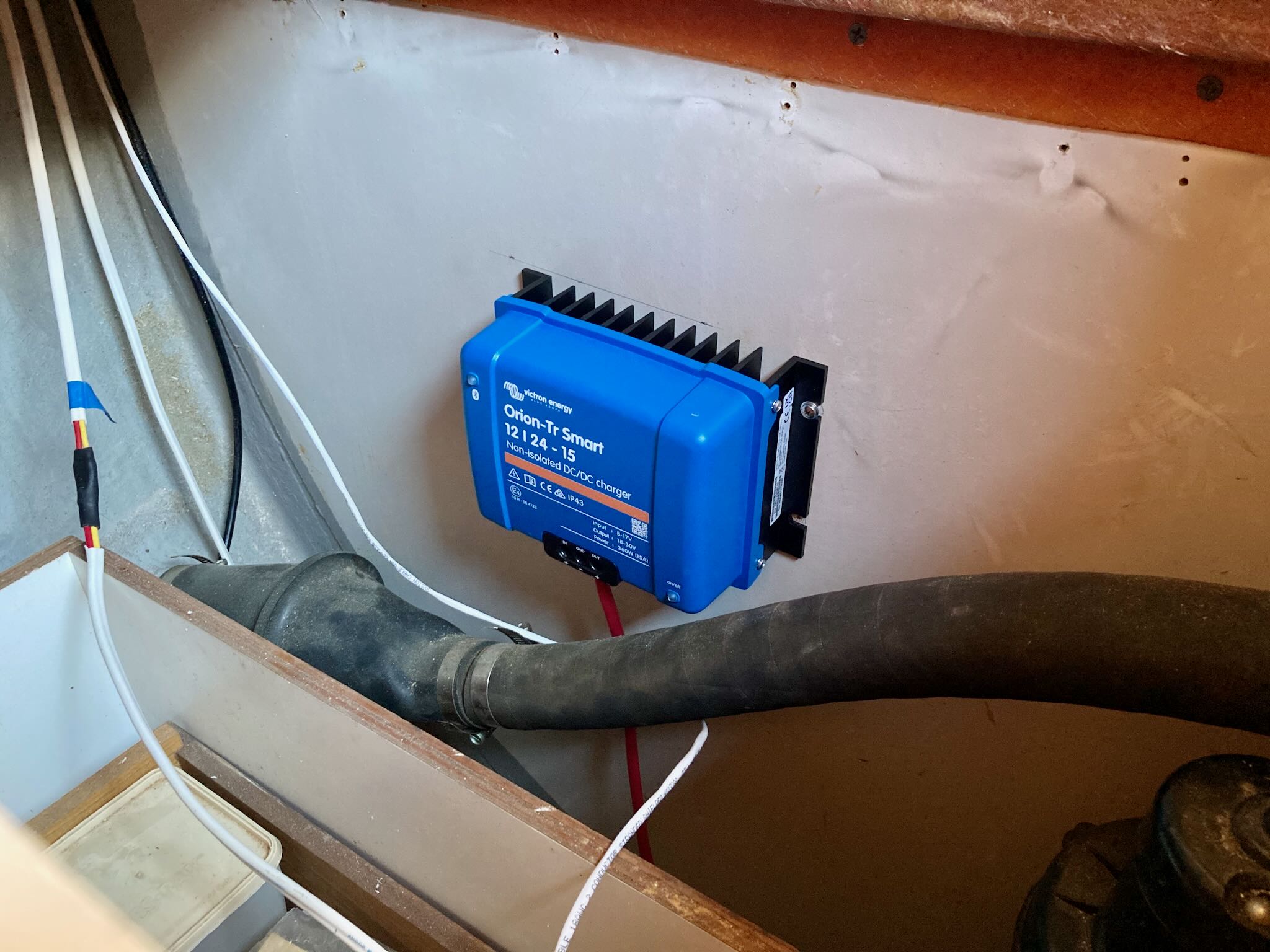

• This week’s project was to install a DC-DC charger which will charge the house battery from the alternator on the engine. The engine electrics all run at 12VDC with a standard car/lawn mower type battery. My house battery is a LiFePO4 with a nominal 24VDC (actually closer to 29V when fully charged).

    Nate identified the alternator as having a rating of 35 amps. A rule of thumb I heard is that the DC-DC charger should be limited to about half that, so the starter battery and engine can get the power they need without overloading the alternator. I figured the Victron Orion-TR Smart charger would do the job.

    Victron Orion-Tr Smart DC-DC charger mounted on a vertical surface above the exhaust hose and a shelving unit.  Several wires are visible in the frame.  The charger is not yet fully connected to the wires.
    I installed the charger on a wall in a utility space below the nav desk. This location was ideal because it is close to my battery disconnect switches and both (engine and house) distribution panels.

    I took the opportunity to reroute some wires around the engine as well, and connect the new main disconnect switch for the engine starter battery.

    Two main battery switches. The house battery runs through the switch on the left, and the engine battery runs through the switch on the right.

    The instructions from Victron suggested configuring the charger (via Bluetooth and the VictronConnect app) while it’s off and only the source power is connected. So that’s what I did. I used the charger’s internal meter to note the voltage of the system at several key points. With the engine off, the battery rested around 12.7V (good to know, the battery—purchased used—appears healthy). Within a few seconds after starting the engine, the alternator increased the voltage to around 14.0V. Over the next few minutes, presumably as the starter battery regained its charge, the system voltage increased further to 14.6V. It continued to slowly rise beyond that level as well. I used these voltages as references for programming the charger’s settings for engine run detection.

    It turns out that (even as smart as it is) the charger does not have a setting to adjust the maximum charging current. I wanted to set this to draw about half of the alternator’s rating. This would be 17.5A on the 12V side, or a little over 7A at 29V. Instead, the charger will adjust the current dynamically to maintain input voltage above a certain threshold, the shutdown voltage. So for my purposes I ended up setting the shutdown voltage quite a bit higher than it might need to be otherwise. This will ensure that the alternator does not overheat and that priority will be given to the starter battery to get a good recharge right away.

    For now I have to guess, because I don’t have an accurate current meter. A good battery monitor is on order, though, which will let me fine tune the charger if needed. For now, I’ve set the shutdown voltage to 14.1V. This means that the charger will not do any charging when the voltage on the engine side is below 14.1V. I also set the start voltage to 14.6V, which allows the engine starter battery to have at least partially recharged before this charger kicks on. A third parameter, start delay, I set to 14.4V with a 120 second delay. This means that if the voltage is about 14.4V for over 120 seconds, the charger will also turn on. Hopefully this results in a good balance between topping off the starter battery while also giving some current to the house battery.

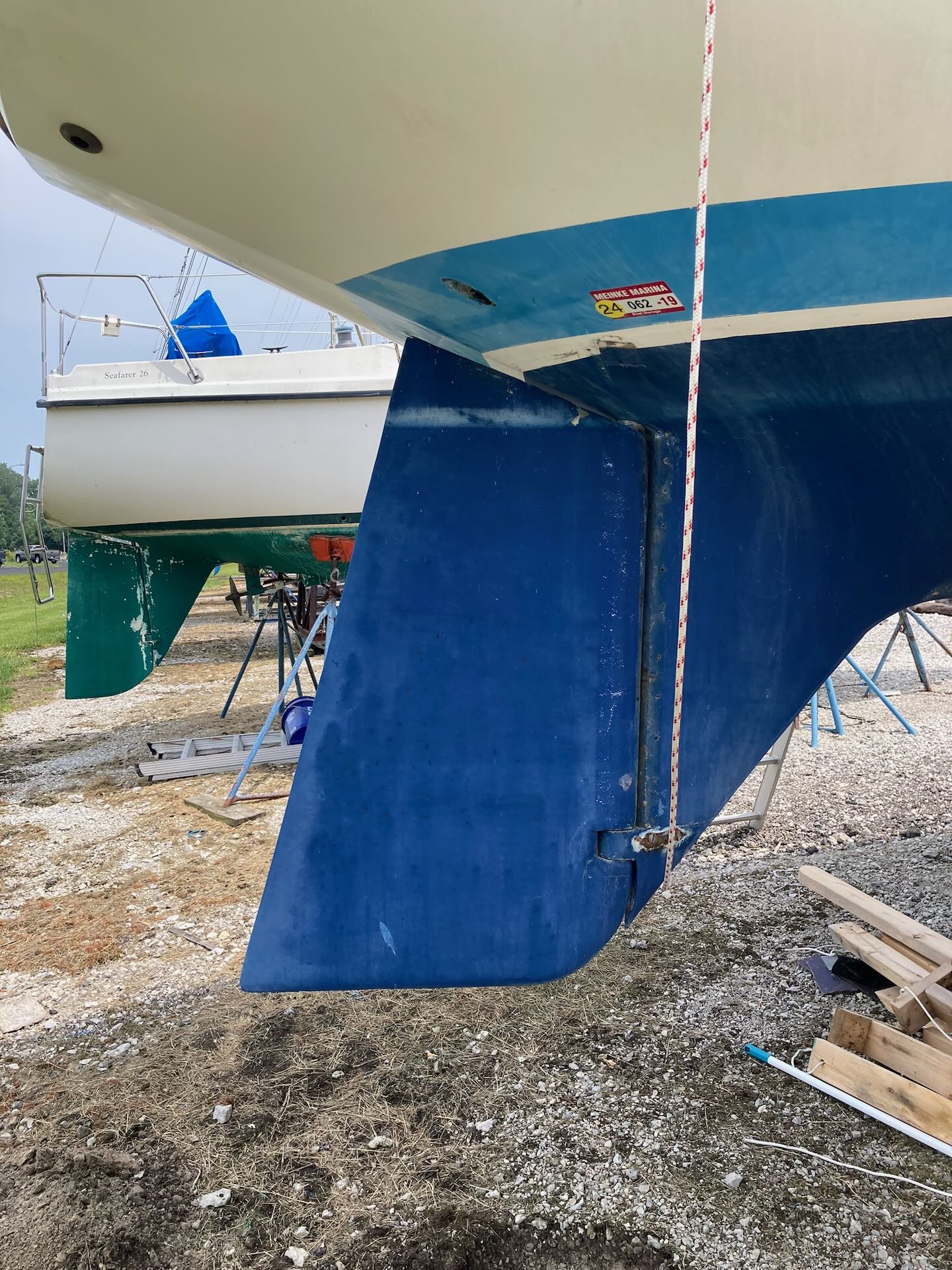
  • The first order of business before getting the boat in the water was to repair the rudder. There were signs that water had gotten inside, most visibly from a crack along the top edge of the rudder (against the hull).

    While it might have been possible to execute the repair while the rudder was on the boat—and many professionals will do the work this way—I decided that removing it and doing the work in a more convenient location would be far easier for me. But, of course, that meant I had to figure out how the rudder comes off the boat. This is not a procedure that the manufacturer intended to be done very often, if at all.

    Simply speaking, a bronze piece bolted to the foot of the skeg contains a bearing where the base of the rudder post rests. Remove two bolts and everything comes off the skeg. The rudder post exits the hull downward, which means that we needed enough clearance under the hull for it to come out. We got lucky in that by digging out a few inches of gravel we were able to create this clearance. If the cradle was not set on the edge of a small hill, we likely would have had to lift the boat off the cradle in order to remove the rudder.

    Once off the boat, repairing the rudder was a simple job of removing damaged material and then rebuilding the foam-core rudder with new two-part expanding foam and a new fiberglass skin.

  • Ever since I was a kid, I had a dream that someday (someday) I would live aboard a sailboat and sail around the continent. As my partner and I started dreaming together, we got into the habit of watching sailing videos on YouTube. One sailor repeated the advice that the best time to sail is now: if you are thinking about it, don’t wait until the perfect opportunity comes along to sail on the perfect boat. Just get out there and enjoy the wind.

    I idly made a comment about this dream and this advice to a friend, simply making conversation with someone whom I knew to be a sailor. To my surprise, a few days later they contacted me letting me know that they had an older sailboat they were thinking about selling. They’d give me a good deal. Now, in all seriousness, we had not been looking at the market at all. We were still in the dreaming phase. But since a friend offered for us to look at the boat, we figured it couldn’t hurt.

    Long story short, it was an offer we couldn’t refuse. Even though the timing was not what we expected (I’m about a year out from finishing school, and my partner is also in the midst of orchestrating a career change), the boat was a fantastic entry into sailing—and potentially living aboard. The price was affordable, and the condition of the boat was just right for our ability to take on a project.

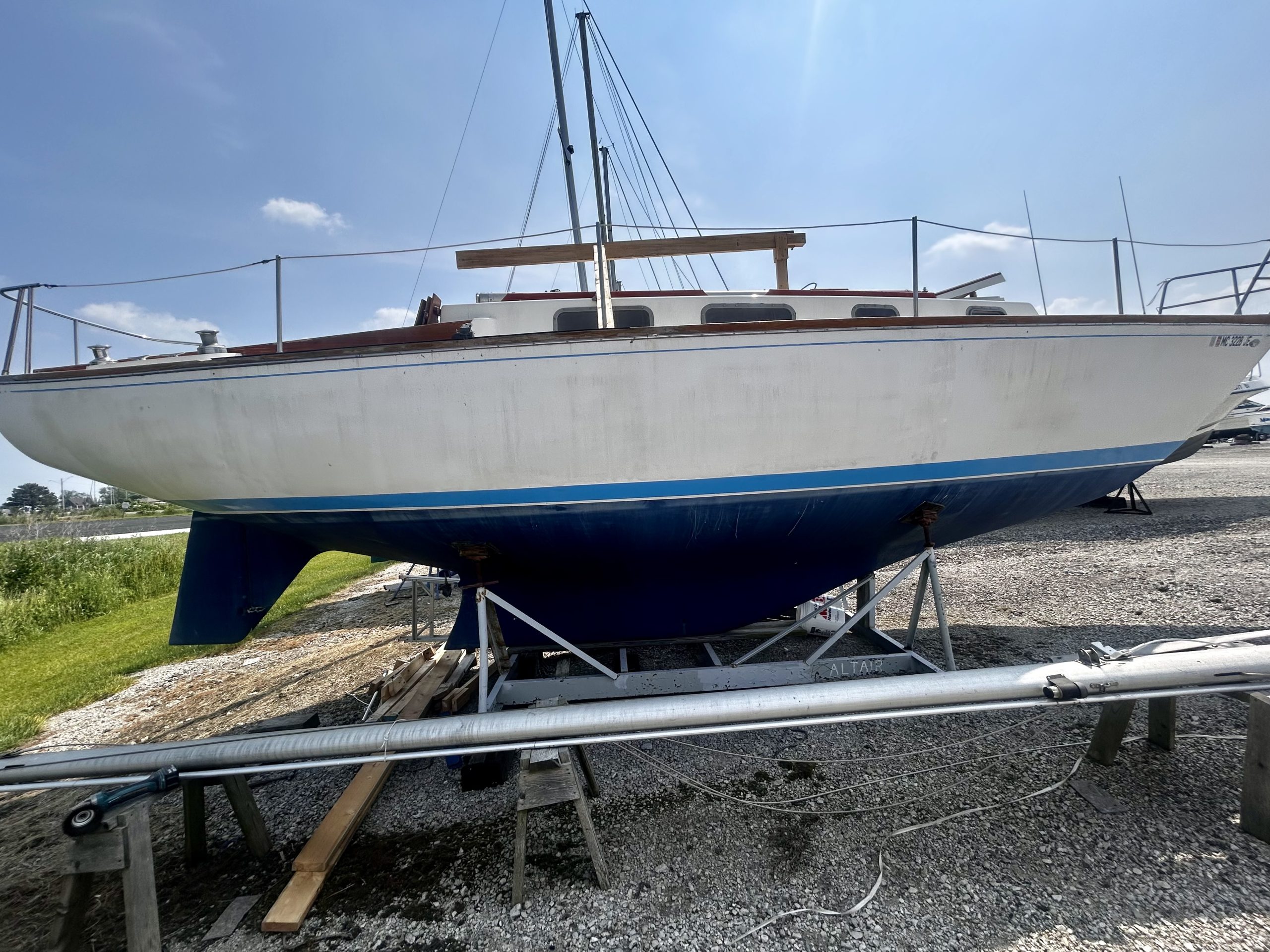
    A dirty old sailboat, mast horizontal in front of the hull, on its cradle in a gravel lot
    Altair on the hard (and a bit dirty), when we bought the sailboat.

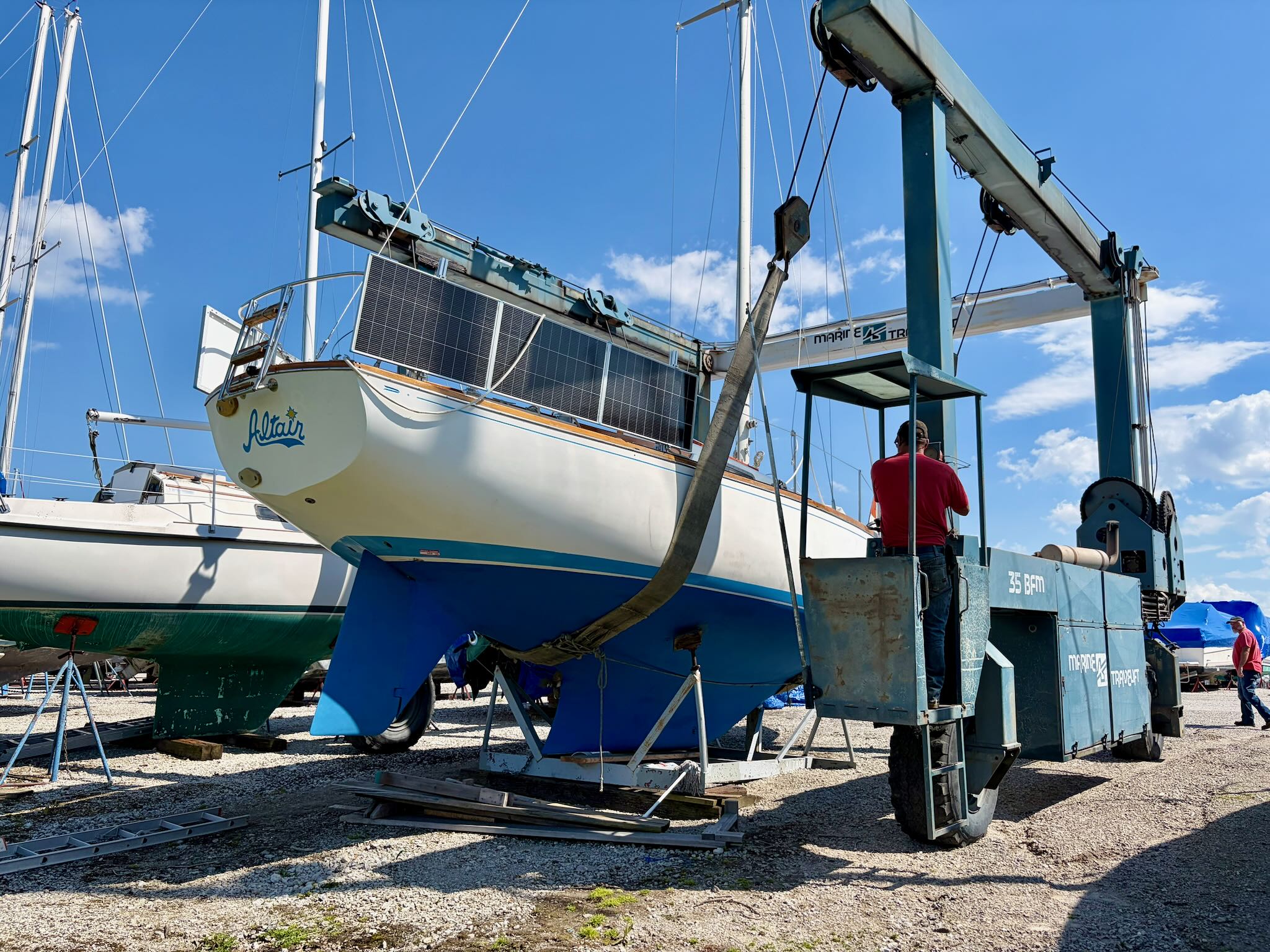
    So, in June, we jumped in and became boat owners! Altair, a Tartan 34C, had been sitting on the hard for a few years undergoing significant maintenance. The previous owners re-cored the deck and began a major cabin refit. Sails and rigging were in good condition, so with the new deck there were really only two major projects to get her ship shape and in the water. The first (and critical one) was that the rudder had some water infiltration and needed repairs. The second was to finish what was started with refitting the cabin, which involved all new electrical systems and finishing out the teak trim.

    The goal was to get her in the water before the end of the season. Projects ahoy!