We had been planning to splash today in the morning, but because of the marina scheduling they actually did it last night! That gave us an easy start to the day today, since she was already in the water.
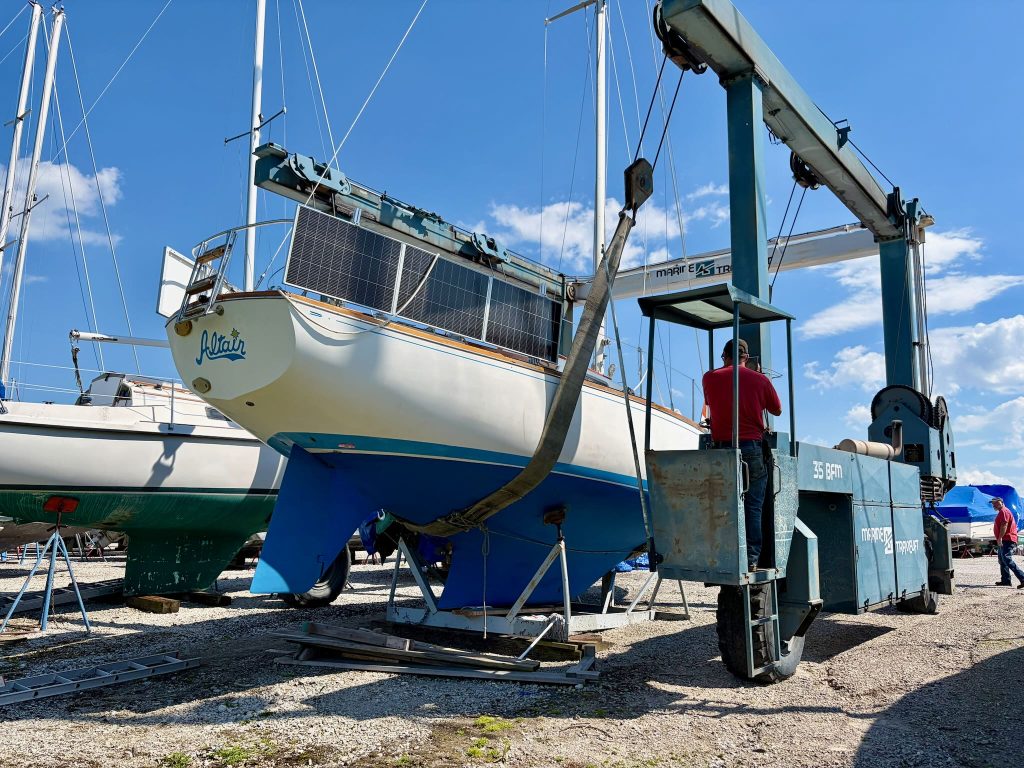
Today’s adventure was to sail from the marina where we wintered to our new marina. This year we’re keeping the boat closer to our land home, about 30 miles north across the lake. We got lucky (or our forecasting was spot on, who can say which) and the weather was excellent. We also got a chance to shake down and try out some new equipment.
Among the new additions I added over the winter: solar power, Orca Core 2 for navigation, and a Raymarine autopilot.
Solar Power
The first major upgrade of the winter was 600 watts worth of solar panels. I was able to get this up and running before the end of 2025 to take advantage of the tax credits before they expired. But of course using the power on the water is far more interesting than using it on land.
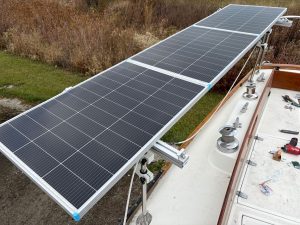
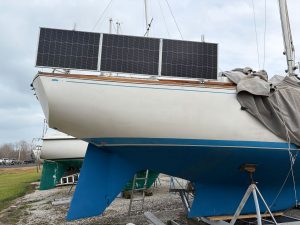
This is plenty more power than we technically need at the moment, but it will give us room to grow into as we add more electric appliances. At some point soon we’ll likely expand with a refrigerator and maybe an induction cooktop. But before we do that, our battery is the new weak point in the system. With only 40 Ah of storage we have plenty to run all the navigation equipment, but not much else.
The real test today was confirming that the mounts were sufficient to hold the panels against a moderate breeze, and that they don’t interfere with moving about the cockpit to operate the sails. Everything feels good so far!
Orca Core Navigation
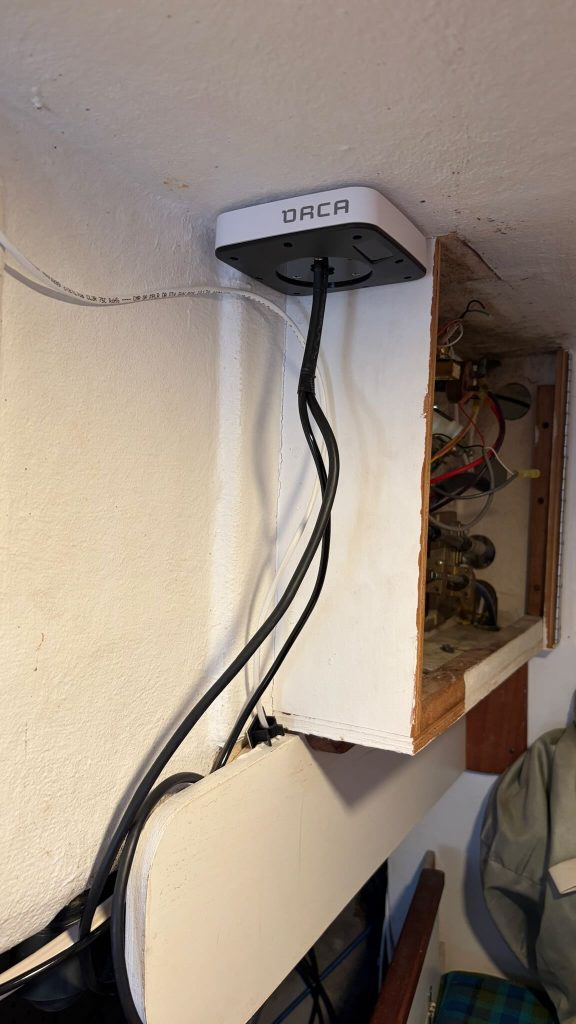
As I’m sure you’ve heard, Orca is a modern navigation system that does what a lot of chart plotters do, but in a relatively open platform. That’s not to say it isn’t proprietary, but it’s designed to connect to most other systems using modern protocols (NMEA 2000 and WiFi, most importantly). With the Core 2 connected to our ship’s NMEA backbone, I was able to pull up the software on my smartphone to see our course and speed, along with data from our depth sensor and battery shunt.
The boat does not have a permanent connection to the Internet, but if/when we add that the Orca will be able to relay all its data to us via their cloud servers, meaning we’ll be able to monitor the boat’s location and systems even when we’re not on board. I’m looking forward to that peace of mind, if we leave her on anchor while we go into a port for dinner or supplies!
The most impressive feature of Orca comes with its integration into the autopilot. Orca with its GPS and course plotting, plus the array of sensors in the Raymarine Evolution autopilot system, work fantastically together to keep the boat on course.
Autopilot
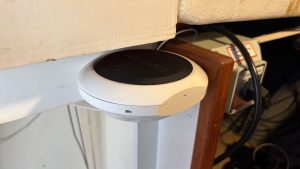
Our new autopilot system is the Raymarine EV-100 Tiller Pilot. This is a pretty slick system by itself. The EV-1 sensor core contains an array of sensors that are able to follow the motion of the boat through waves and compensate effortlessly to keep her on a straight course. I was impressed at how well it did so. The work it was doing became especially obvious when I took over manual control for a few minutes to maneuver out of the way of a passing freighter. I was able to see what it was doing with the tiller to hold the course before, but trying to steer myself through the same waves gave me added appreciation for the system’s efforts.
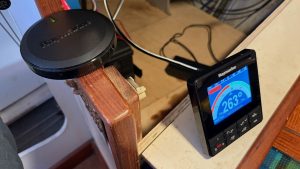
This system by itself lacks a GPS, so it is only able to follow a magnetic heading, not a course to a waypoint. However, coupled with the Orca, the two systems work together to keep the boat on a track that I added in via my smartphone. To be fair, Orca actually helped me plot a course when it’s software took into consideration water depth and forecasted wind direction, to give me an optimal route to take to our destination (very slick)! It was a lot of fun to watch Orca continually adjust Raymarine’s magnetic heading to guide us precisely along the programmed route.
Technical notes
Before I got everything up and running, I had some faulty ideas about how it all works. Orca’s website has some information about integrating with Raymarine autopilots, but it was incomplete. Their website’s AI chatbot made things worse, giving me some incorrect details (good thing I didn’t trust it).
The short of it is this.
The Raymarine Evolution system includes three components. There’s the ACU-100 actuator which is the piece that actually operates the linear motor that moves the tiller (this piece can also run a wheel autopilot or a hydraulic actuator, depending on your boat). Then there’s the EV-1 sensor core, which is a pack of sensors that give the autopilot all the fancy position data it needs to operate well. Third, there’s the autopilot control head, something like the p70s.
Since I already knew I would have Orca on board, and I was planning on using Orca to control the autopilot, I was inclined to believe I didn’t need all this equipment. The Orca Core contains all the same sensors as the EV-1 sensor core—and then some: GPS specifically. Plus, the autopilot control head seemed superfluous since I’d be using Orca software to control the autopilot. So, theoretically, it seemed like all I would need from Raymarine is the ACU and tiller drive motor. Right?
Well, in practice, that’s not how it works. Due to proprietary reasons, the ACU will only accept position data from the EV-1 sensor core, even though the same data is available from another device on the network. And, even though Orca can control the basic operation of the autopilot, the Raymarine control head is required to access the setup and configuration settings. So, if you’re inclined to install a similar system, you’ll need the full kit from Raymarine even though it’s kind of duplicating a lot of the capabilities of Orca.
Besides, a little redundancy is always a good thing. If for some reason the Orca stops working, for example, the autopilot will still work as a standalone system.
Conclusion
One thing that is missing from our setup, now, is an onboard wind sensor. With apparent wind data, Orca would be able to monitor our polar efficiency and plot courses more precisely while accounting for actual wind conditions instead of simply the forecasted conditions. I had thought that this level of data was a luxury for us, and only useful if we were racing, but after seeing the potential and how well Orca does so far, I find myself definitely wanting to add a wind sensor just to round out the tech.
Somewhere I got the idea that S/V Rennaissance did some cool stuff that not only got them a full-fledged onboard weather station, but were also able to share that data out to weather aggregators on the open web. I’ll have to check that out!
Leave a Reply